

In the Sultanate of Oman, it is impossible to understand the transformation the country has undergone over recent decades without considering the development of higher education and scientific research. At the heart of this transformation stands Sultan Qaboos University in Muscat, as the Sultanate’s first public university and one of its most prominent centers of education and scientific research.
For those interested in cultural and scientific tourism, the university is not merely an architectural site to be viewed during a visit to Muscat. Rather, it offers an opportunity to explore an institutional dimension of modern Omani history: how the country moved from building a higher education system to establishing an academic institution that today participates in scientific research and international knowledge networks.
From a National Project to a University with an International Presence
The story of Sultan Qaboos University began when His Majesty Sultan Qaboos bin Said announced the project to establish the university in 1980. Construction began in 1982, before the university welcomed its first cohort of students in 1986. It began with five colleges: the College of Medicine and Health Sciences, the College of Engineering, the College of Agricultural and Marine Sciences, the College of Education, and the College of Science. The institution then gradually expanded, with the College of Arts established in 1987, the College of Commerce and Economics in 1993, the College of Law in 2006, and the College of Nursing in 2008. Today, the university comprises nine colleges covering a wide range of academic disciplines.
According to university data published in 2026, the cumulative number of graduates since its establishment reached 74,005, including 66,526 bachelor’s degree graduates and 7,479 postgraduate graduates. The university also recorded an 85% satisfaction rate among employers regarding its graduates in its 2025 performance indicators, in addition to publishing 1,851 papers in peer-reviewed academic journals during the same year.
Sultan Qaboos University in Global Rankings
One of the important indicators for understanding the position of Sultan Qaboos University is its presence in international rankings. In the QS World University Rankings 2027, the university ranked 306th globally, 28 places higher than its 334th position in the 2026 edition. The QS World University Rankings 2027 evaluated 8,808 universities from 106 countries, with 1,504 institutions included in the final ranking.
At the Arab level, Sultan Qaboos University ranked eighth in the QS Arab Region University Rankings 2026, making it the highest-ranked Omani university in this ranking. The ranking includes a large number of higher education institutions across the Arab region.
The University’s Performance Across Academic Disciplines
Subject-specific rankings reveal a more precise aspect of the university’s performance. In the QS World University Rankings by Subject 2026, Sultan Qaboos University was ranked in 20 academic disciplines, with the university placing in the global top 500 in 19 of them.
Of particular note are the rankings of several disciplines:
Petroleum Engineering: 17th globally
Nursing: 25th globally
Library and Information Management: 44th globally
These results acquire particular significance when viewed in light of the nature of the Omani economy and society, as some of the university’s academic strengths are connected to fields of strategic importance to the Sultanate, such as energy, engineering, and health sciences.
Scientific Research: From Education to Knowledge Production
The importance of the university extends beyond teaching and the education of students. Scientific research represents one of the fundamental components of its academic activities. According to a report published by the university in January 2026, the number of research outputs indexed in the Scopus database exceeded 2,100 in 2025, with the university reporting approximately 35% cumulative growth in research output between 2023 and 2025..
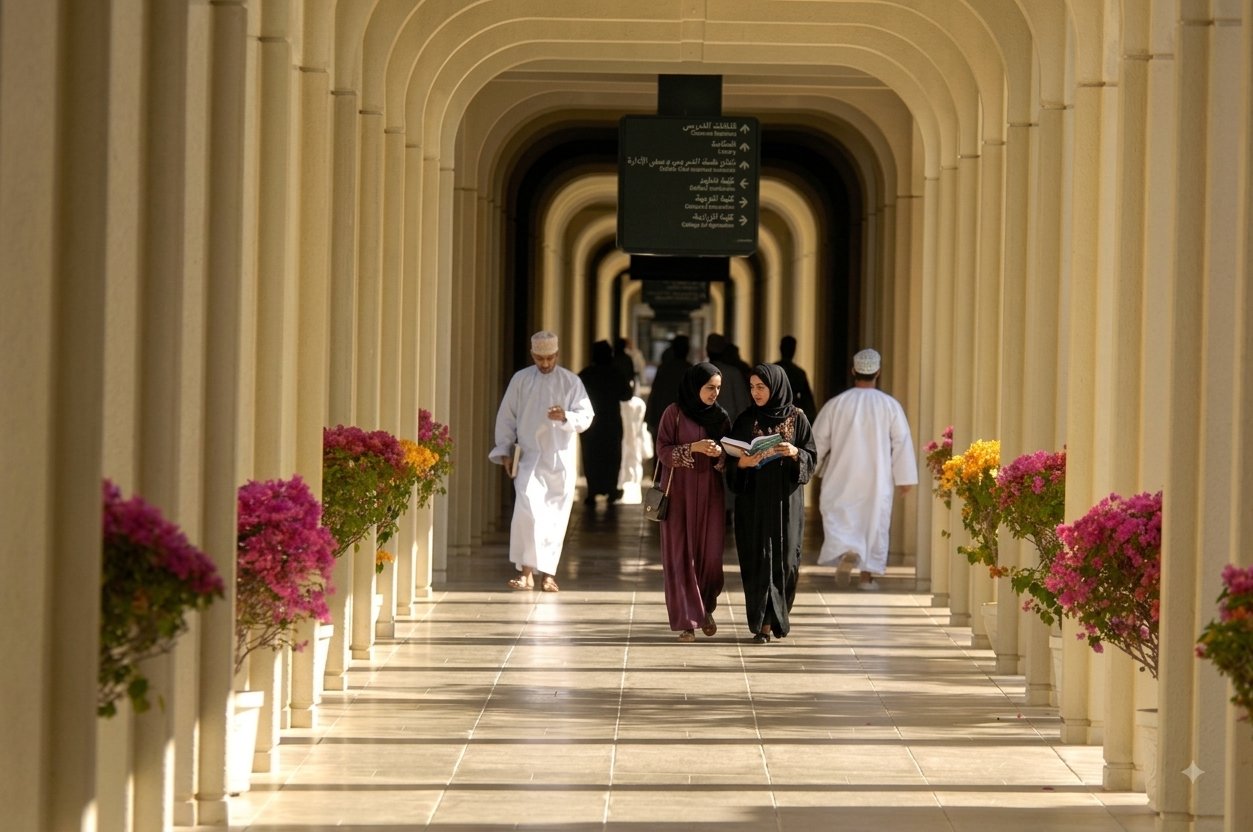
The university’s research environment encompasses a wide range of fields, from engineering, energy, and medical sciences to water, the environment, marine sciences, and technology, in addition to the humanities and social sciences. The university also has specialized research centers, including the Omani Studies Center, which focuses on historical, social, and cultural studies related to Oman.
This center serves as a source of social, cultural, and historical studies on Oman and receives researchers interested in Omani Studies from around the world. It also organizes conferences, seminars, lectures, and workshops, and publishes books and studies related to Omani society, culture, and heritage.
International Presence of Researchers
The university’s international presence can also be observed through some of its faculty members and researchers. At the College of Medicine and Health Sciences, Dr. Srijit Das was listed in 2024 among the top 2% of researchers worldwide in the field of medicine. At the College of Engineering, Dr. Mohammad Reza Nikoo received the Omani National Research Award in 2024 and was listed among the top 2% of scientists worldwide.
The university’s international presence is not limited to the applied sciences. Among the academic and literary figures associated with Sultan Qaboos University is the Omani writer Dr. Jokha Alharthi. Her novel Celestial Bodies (Sayyidat al-Qamar / سيدات القمر) won the Man Booker International Prize in 2019, making her the first Omani woman to receive the award.
Architecture as Part of Institutional Identity
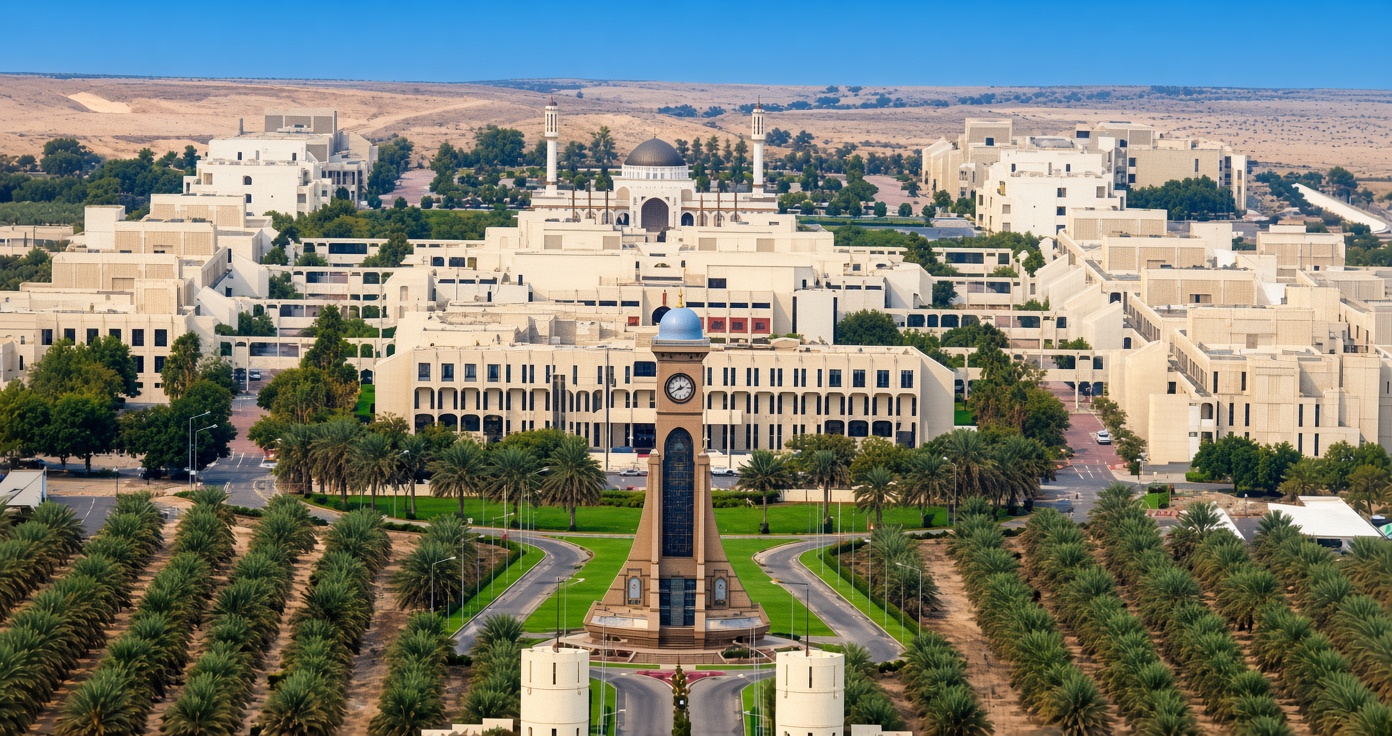
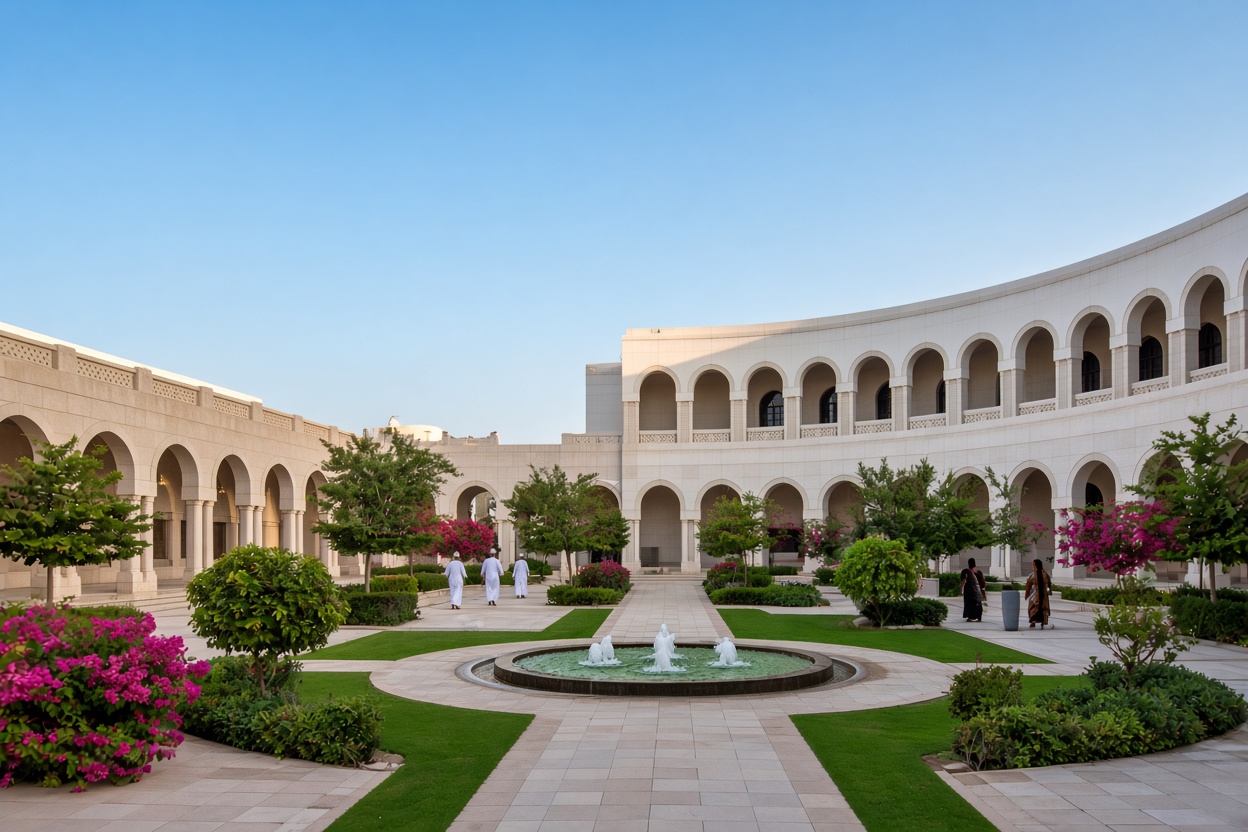
In addition to its academic value, the campus of Sultan Qaboos University possesses clear architectural and cultural significance. The university buildings were designed in a valley surrounded by the foothills of Oman’s mountains, using white and pink sandstone, along with arches, interior courtyards, and elements inspired by Omani and Islamic architecture. The campus was also designed along an axis extending from the main gate, through the administrative and academic buildings, and ultimately to the university mosque.
The university mosque occupies a prominent position within the overall campus plan. It stands on elevated ground at the western end of the main axis, and its large dome and minarets can be seen from various points within and around the university. This architectural approach reflects a clear attempt to combine the modern function of a university institution with Omani and Islamic architectural references.
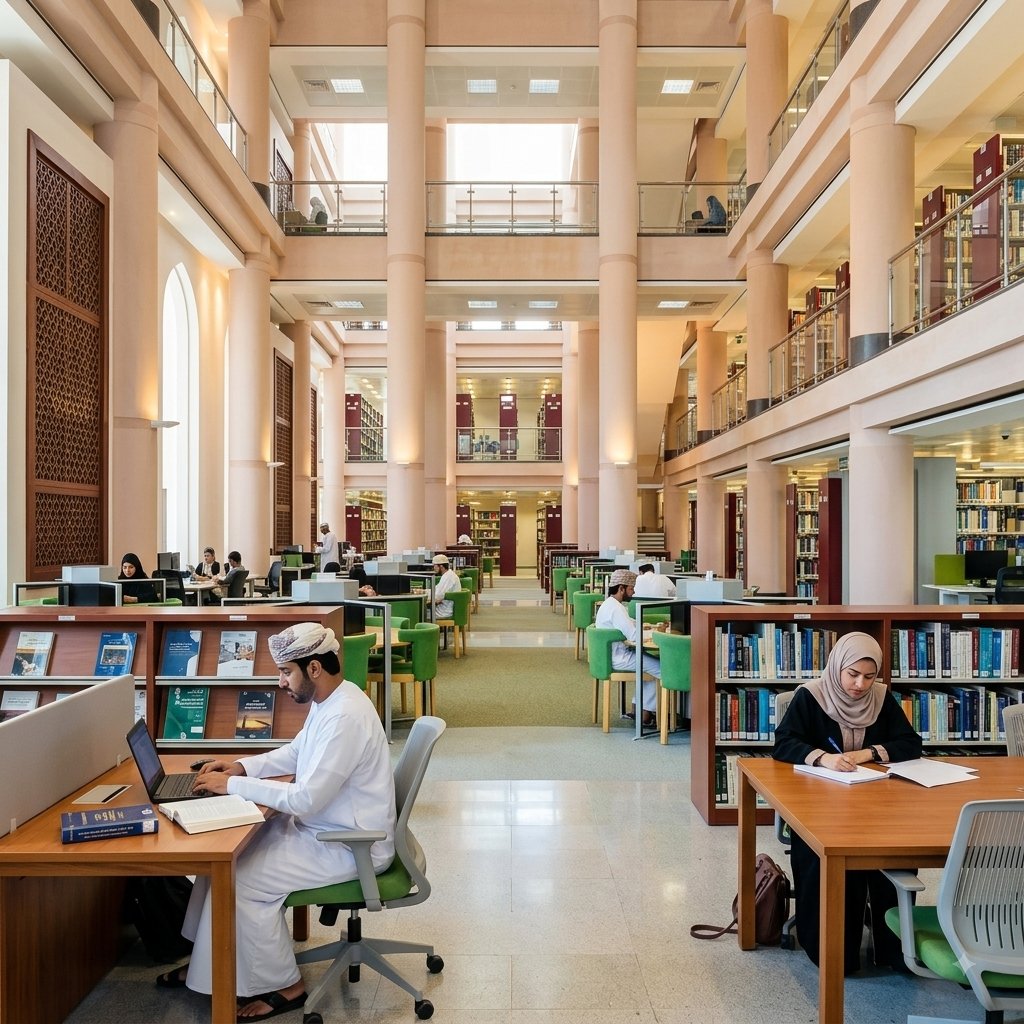
The university’s identity as a knowledge institution is further complemented by its research and library infrastructure. The Sultan Qaboos Cultural Center houses the university’s main library, which was designed as part of the university’s academic infrastructure, alongside other cultural and academic facilities. The university also provides a research environment for specialists in Omani Studies, including researchers coming from outside the Sultanate.
A University Worth Including in a Scientific Tourism Itinerary
Sultan Qaboos University is not merely a witness to the educational renaissance in Oman; rather, it is one of the institutions through which one can trace the evolution of this renaissance into a stage characterized by knowledge production, research, innovation, and international academic collaboration. Taken together, these indicators illustrate the university’s expanding role in higher education, scientific research, innovation, and international academic collaboration, while its campus also forms an important part of Muscat’s modern architectural and cultural landscape.
From this perspective, visiting Sultan Qaboos University is not merely a stop at a university building for those interested in scientific and cultural tourism. It offers an opportunity to explore a chapter of modern Oman’s history through an institution that brings together higher education, scientific research, cultural studies, and architectural identity within a single campus.