

In the heart of Old Muscat, overlooking Al Alam Palace across the ceremonial road, stands the National Museum of Oman, one of the most important cultural landmarks in the Sultanate of Oman. The museum is not merely a place for preserving and displaying archaeological objects; rather, it is a space in which Oman tells its story—the story of people, land, sea, trade, religion, arts, customs, and traditions—from the earliest evidence of human settlement in the ancient Oman to modern Oman.
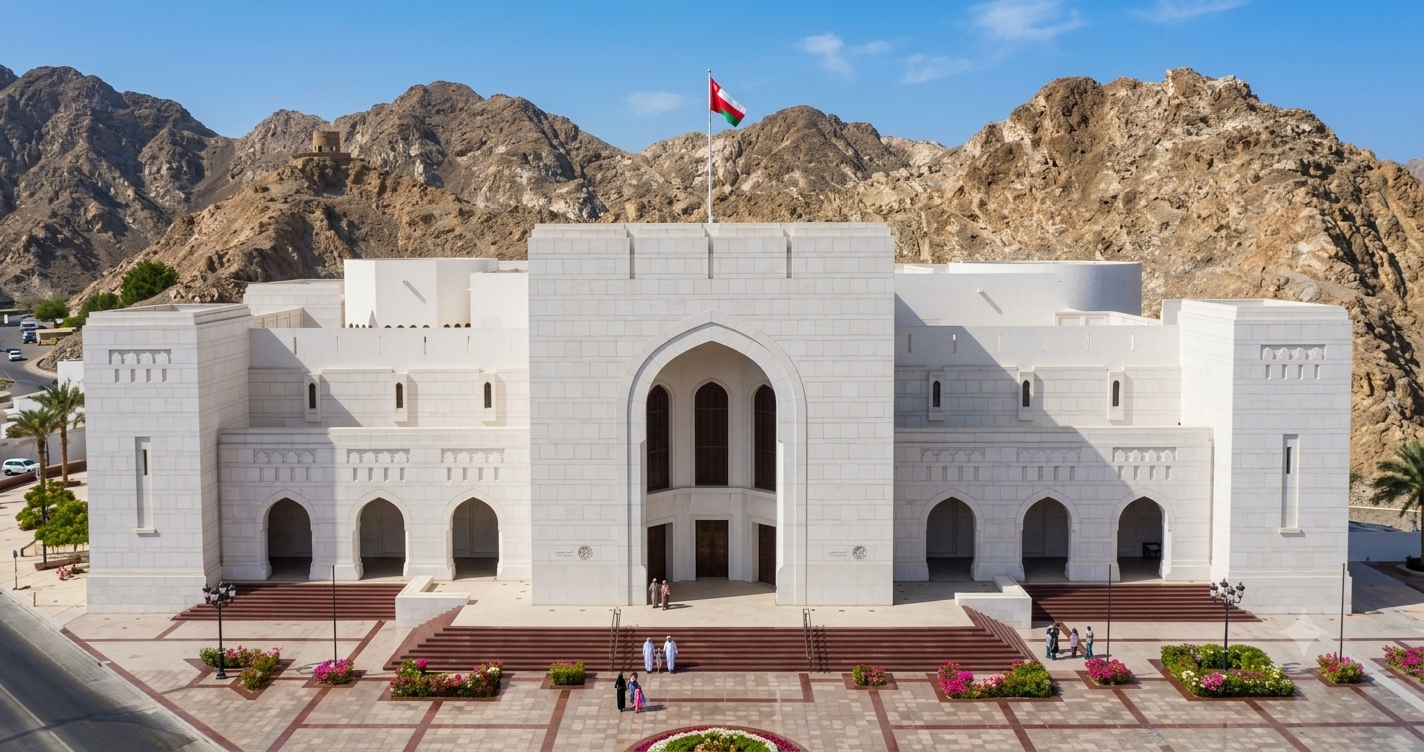
The National Museum was established by Royal Decree in 2013 as the principal national cultural institution responsible for presenting Oman’s tangible and intangible cultural heritage. The current building was specifically designed as a national museum, with a total area of approximately 13,700 square metres, of which 4,000 square metres are dedicated to 14 permanent exhibition galleries, in addition to a temporary exhibitions area.
Today, the museum houses more than 7,000 objects, alongside immersive digital experiences and specialized facilities for conservation, restoration, and education. The significance of the museum lies in the fact that it does not merely present a collection of individual objects; instead, it constructs a sequential historical narrative that explains the development of Omani society and its relationship with the environment, water, the sea, trade, religion, architecture, and the wider world.
The visit begins with The Land and the People Gallery, which places Omani people within their geographical and environmental context. From an anthropological perspective, the gallery provides an entry point for understanding the relationship between the population and Oman’s diverse environments, from coasts and plains to mountains and deserts. This starting point is particularly significant because the history of Oman cannot be separated from geography: climate, water distribution, maritime location, and natural resources have all contributed to shaping patterns of settlement, economy, and society.
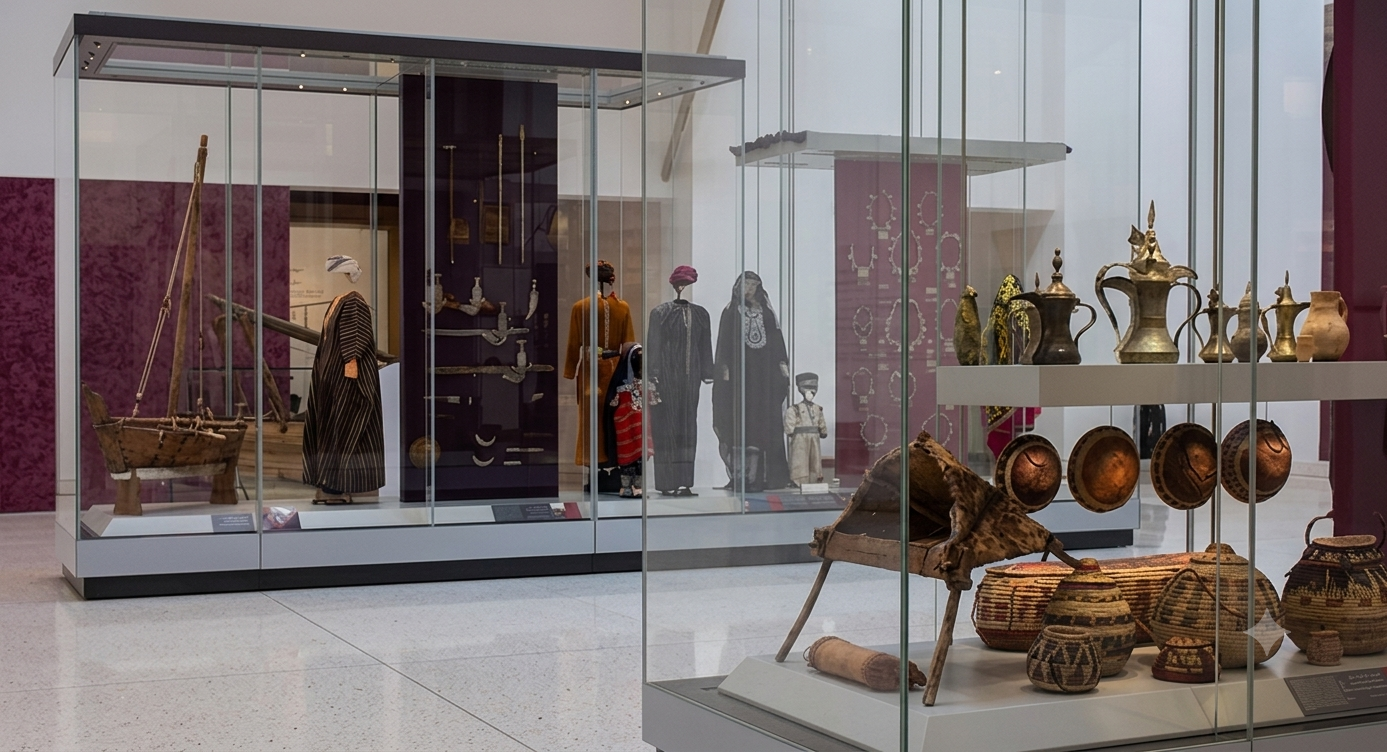
The journey then continues to The Maritime History Gallery, which documents Oman’s relationship with the sea over approximately five thousand years. The gallery highlights navigation, shipbuilding, fishing, and maritime trade, and demonstrates how the Omani coast became part of a vast network extending, particularly during the Islamic period, from China to East Africa. It also displays scale models of traditional vessels, helping to explain the maritime technologies and navigational knowledge developed by Omani communities.
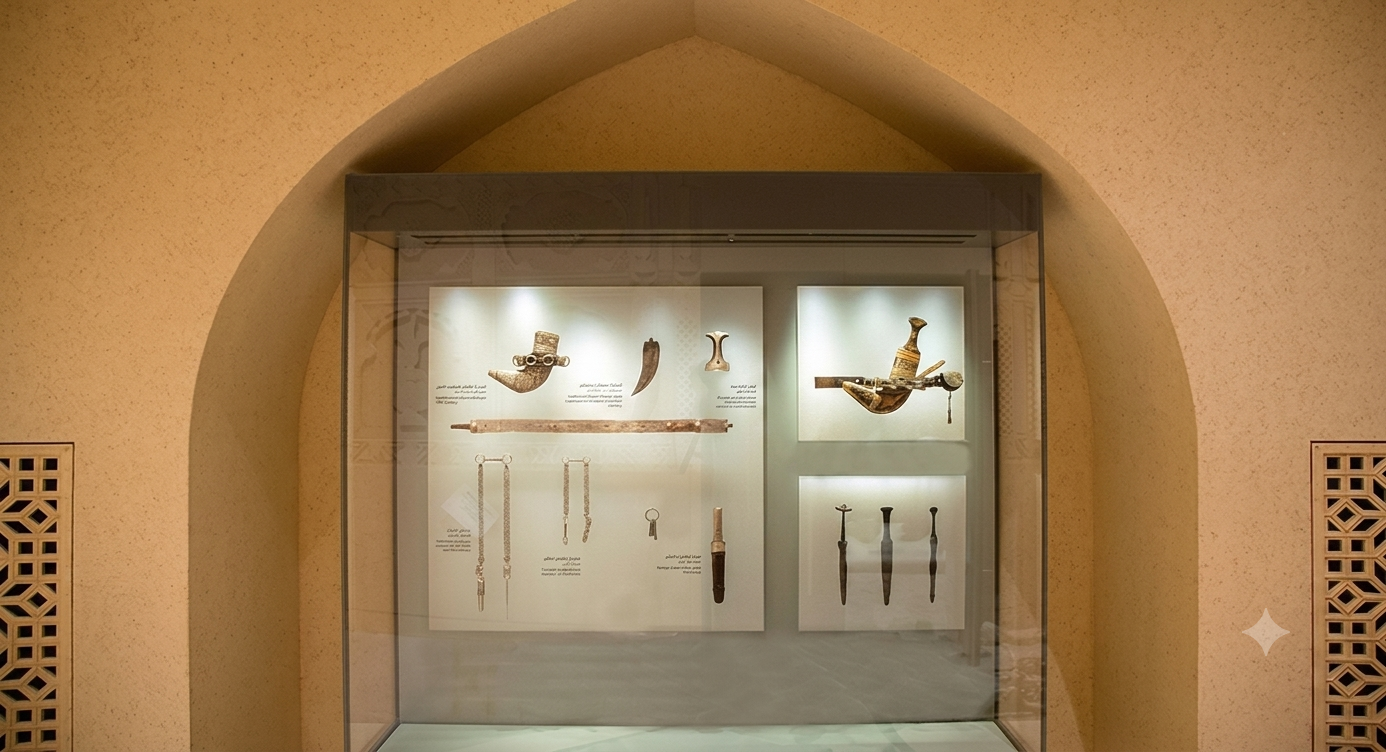
The Arms and Armour Gallery offers a historical and technological interpretation of the development of traditional weaponry in Oman, from prehistoric times to the beginning of the twentieth century. The gallery is divided into two main sections: traditional arms and armour, including swords, daggers, spears, axes, arrows, and the Omani khanjar; and a section devoted to gunpowder and artillery, containing firearms and cannons. A notable feature is that the gallery’s architectural design was inspired by one of the towers of Al Hazm Fort in Al Batinah South Governorate, creating a direct relationship between military architecture and the collections on display.
The Civilisation in the Making Gallery focuses on Omani architectural heritage and its development over more than five thousand years, from the Magan Civilization in the third millennium BCE to the modern era. Its themes are divided into six areas, including Bahla Oasis and Bahla Fort, historical political capitals such as Sohar, Rustaq, Nizwa, and Muscat, forts and castles, rural palaces and fortified houses, residential patterns, and finally the aesthetics of traditional architecture. The gallery allows architecture to be understood not merely as an aesthetic form, but as a reflection of the political, economic, social, and environmental systems that developed in Oman over the centuries.
The Aflaj Gallery is dedicated to the water-management system that represents one of the most important engineering and social innovations in the history of Oman. It examines Aflaj channels, which use gravity to transport groundwater, spring water, or surface water over sometimes considerable distances for agriculture, domestic use, and economic activities. The exhibits indicate that the roots of irrigation technology in Oman extend, according to archaeological evidence, to the Bronze Age, while thousands of Aflaj remain in use today. It is worth noting that in 2006, five Omani Aflaj were inscribed on the UNESCO World Heritage List.
The Currency Gallery reveals an economic history spanning approximately 2,200 years, beginning with the earliest coins minted in Oman during the late Iron Age and extending to modern digital transaction technologies. A significant portion of the collection consists of coins that were not minted in Oman but arrived through terrestrial and maritime trade networks; some were discovered as coin hoards buried centuries ago. The gallery can therefore be read as a source for studying commercial relations, economic exchange, and political changes, rather than simply as an exhibition of ancient coins.
The Timeline Gallery represents an important architectural and narrative transition between the two floors of the museum. Its circular form was inspired by Nizwa Fort, while a panoramic glass elevator and a spiral ramp connect the two floors. The gallery contains seven display panels designed as “windows” onto key periods of the history of Oman, allowing visitors to move through place and time simultaneously. The gallery also encourages interaction with the public, as visitors’ opinions concerning important historical events may contribute to the future development of the museum’s content.
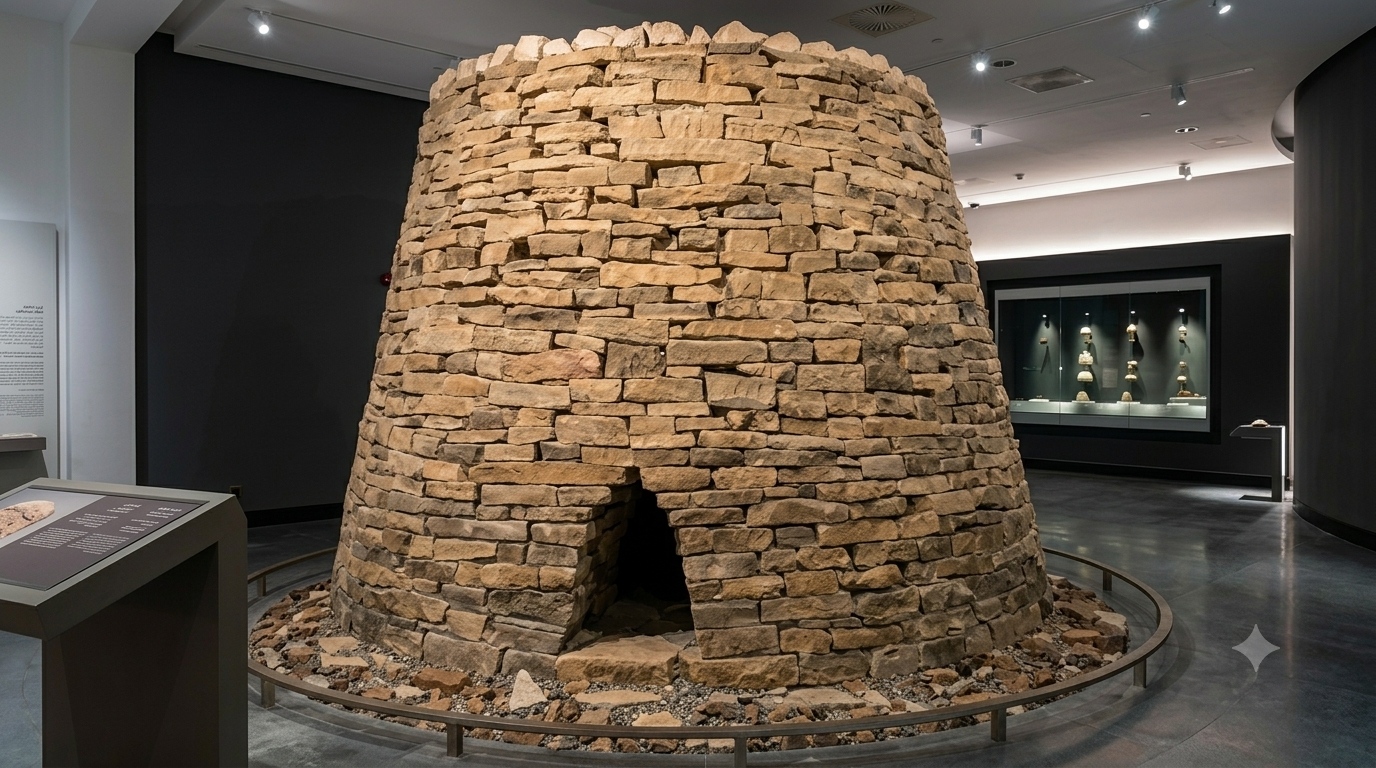
On the first floor, the most specialized archaeological stage of the visit begins with The Prehistory and Ancient History Galleries. These galleries presents a broader framework for the archaeological history of Oman, with exhibits spanning more than two million years of human presence across three principal stages: the Early Palaeolithic, the Bronze Age, and the Iron Age. The exhibits document social and economic transformations during the fourth millennium BCE and the emergence of the Magan Civilization, in addition to Iron Age evidence associated with metals, pottery, clothing, and weapons, as well as evidence of Parthian and Sasanian presence in the region.
Bat, al-Khutm and al-Ayn section is situated within the prehistoric and ancient galleries and represents an important component of Oman’s archaeological landscape during the Bronze Age. The collection is particularly significant for studying settlement patterns, funerary architecture, and trade networks in the ancient southeastern Arabian Peninsula. The Land of Frankincense section also addresses one of the most famous historical resources associated with southern Oman: frankincense, extracted from the frankincense tree. Frankincense was connected to long-distance trade networks from the third millennium BCE, with its trade routes reaching Mesopotamia, the Indus Valley, and ancient Egypt. The museum places this trade within a broader context through the four associated sites inscribed on the UNESCO World Heritage List.
The museum narrative then moves to The Splendours of Islam Gallery, where the heritage of Oman is interpreted within the broader context of Islamic civilization. The gallery is particularly important for understanding how Omani society interacted with the religious, cultural, and scientific transformations that accompanied the arrival and spread of Islam, as well as the development of institutions and practices associated with Islamic life. From a museological perspective, the gallery represents a transition from a primary focus on archaeological evidence to the study of the cultural, artistic, and intellectual heritage that developed within Islamic civilization in Oman.
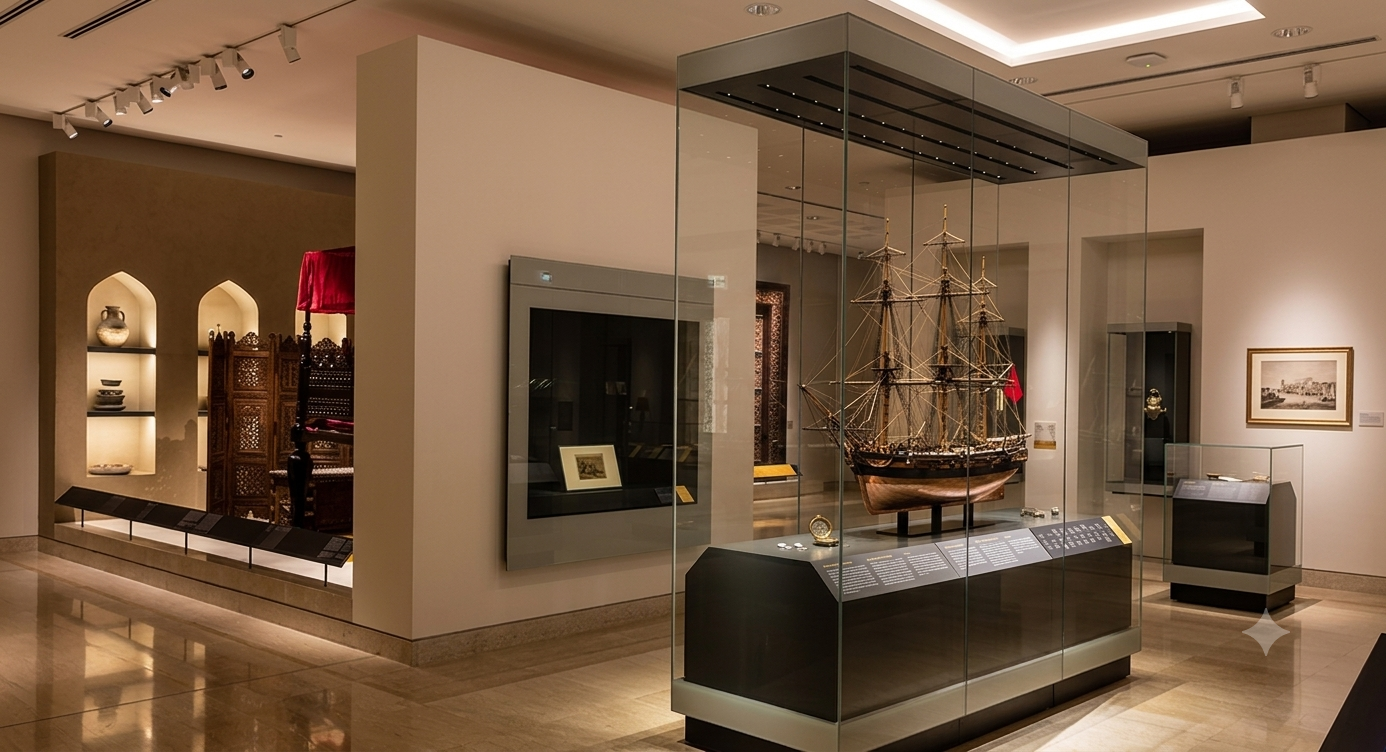
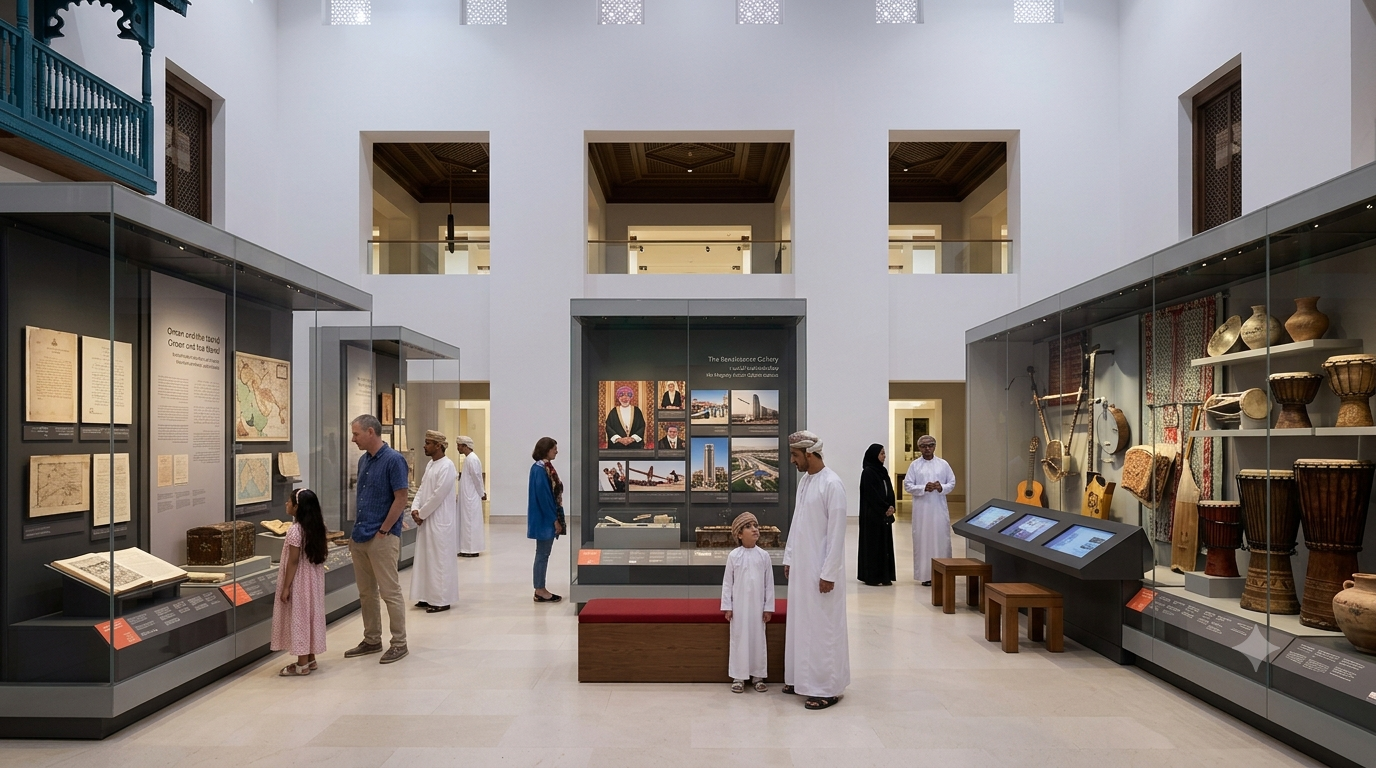
The Oman and the World Gallery addresses the international dimension of the history of Oman, examining more than five thousand years of exchanges of goods, people, and ideas between Oman and other civilizations. Maps, journeys, historical documents, and archaeological objects trace commercial, cultural, scientific, and diplomatic relations with the Arabian Peninsula, East Africa, the Indian subcontinent, the Far East, Europe, and North America. The significance of the gallery lies in presenting Oman as a society connected to the wider world, rather than as a historical entity that developed internally in isolation from its surroundings.
The Renaissance Gallery is dedicated to the period that began in 1970 with the accession of Sultan Qaboos bin Said, which witnessed extensive transformation in state institutions, infrastructure, education, security, foreign relations, laws, and administrative systems. The gallery does not limit itself to celebrating modern transformation; it also connects it with the history of the Al Bu Said dynasty and the continuity of the Sultanate of Oman, extending to the contemporary era under Sultan Haitham bin Tariq. From the perspective of political history, the gallery represents the end of the museum’s chronological sequence by linking historical heritage with the path of building modern Oman.
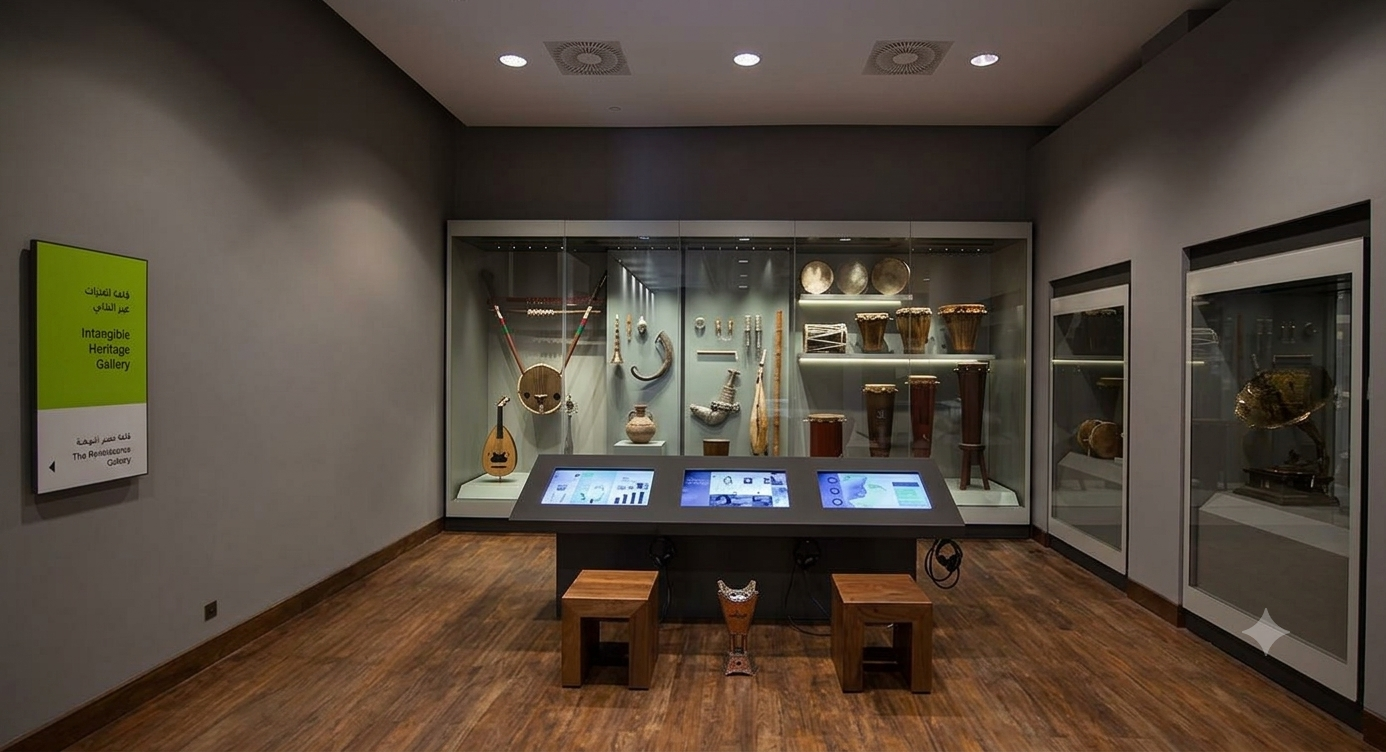
The journey concludes with The Intangible Heritage Gallery, which moves from objects, documents, and buildings to cultural elements that cannot be reduced to a single museum object. Its themes include performing arts, traditional music, customs, social practices, food, and relationships with horses and camels, among other forms of cultural expression. The gallery is particularly significant because it demonstrates that the heritage of Oman is not simply a past preserved behind glass; rather, it is a system of knowledge, skills, and practices, some of which remain living traditions transmitted within society.
Another prominent museum experience is the Collections Gallery, based on the open storage concept. Instead of keeping most of the museum’s collections hidden from the public in storage rooms, this approach allows visitors to observe part of the processes involved in collection management, conservation, and the handling of original objects.
Although the museum focuses on history, the visitor experience is modern and designed to accommodate different audiences. It includes immersive digital experiences, a Learning Centre, advanced facilities for conservation and restoration, an ultra-high-definition cinema, and spaces dedicated to children. Its design also incorporates comprehensive facilities for people with disabilities, and the museum is recognized as the first museum in the Middle East to employ Arabic Braille to serve visitors with visual disabilities.
The National Museum of Oman therefore represents an ideal starting point for discovering Muscat and Oman: it is a place where archaeology, history, the sea, Islam, arts, popular memory, and modernity converge in a single narrative. While Muscat presents Oman to visitors through its streets, palaces, forts, and marketplaces, the National Museum presents Oman through its cultural memory.