

In the Omani cultural landscape, Al-Razha does not appear merely as a folk dance performed on special occasions; rather, it is a comprehensive artistic system that brings together movement, rhythm, poetry, weapons, and collective identity. It is one of the most renowned and widespread traditional arts in Oman, and it has maintained its presence in a number of governorates and wilayats (provinces) of the Sultanate of Oman, particularly during social and celebratory occasions. Men participate in organized rows, while drums, poetic chanting, and the movements of swords and sticks come together in a collective performance characterized by discipline, enthusiasm, and visual display.
In its traditional form, Al-Razha is not a single, fixed format; rather, it is a system of performance styles that differ in rhythm, movement, function, and accompanying poetry. Among its most prominent styles are Hambal, Qassafi, and Lal Al-Oud, each of which has its own place within the sequence of the performance and its own musical and movement characteristics.
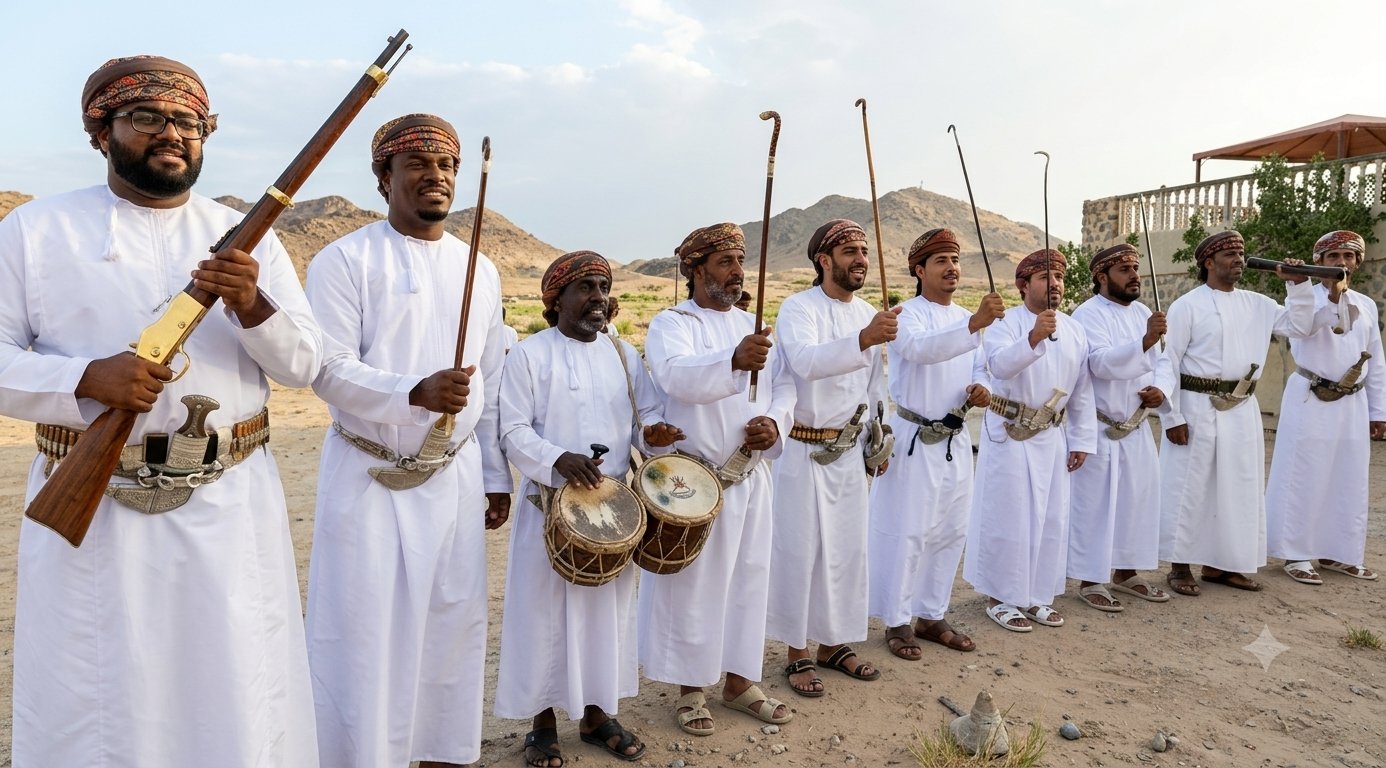
Where Did the Name “Al-Razha” Come From?
The name Al-Razha, according to a common interpretation found in Omani sources dealing with this art, is associated with the verb “Razaha” (رزح), meaning to bear or endure weight and hardship. This interpretation is connected to the image of the swordsman who carries the sword and bears its weight during the performance, particularly when he raises the sword or jumps with it and then lands firmly on his feet. Thus, the name Al-Razha became associated in popular memory with the idea of bearing the weight of the weapon and demonstrating strength and skill in handling it.
This interpretation should not be treated as a definitive and universally agreed-upon linguistic derivation; rather, it is essentially a traditional interpretation of the art’s name. What can clearly be observed in the structure of Al-Razha itself is that the sword, swordsmanship, and physical display constitute one of its fundamental historical elements, alongside poetry and rhythm.
Three Main Styles
One of the most common classifications of Al-Razha divides it into three main styles: Hambal, Qassafi, and Lal Al-Oud. This classification does not mean that Al-Razha is performed identically throughout Oman; performance practices, melodies, terminology, and rhythmic details may vary from one wilayat or region to another.
Hambal: Al-Razha in Motion
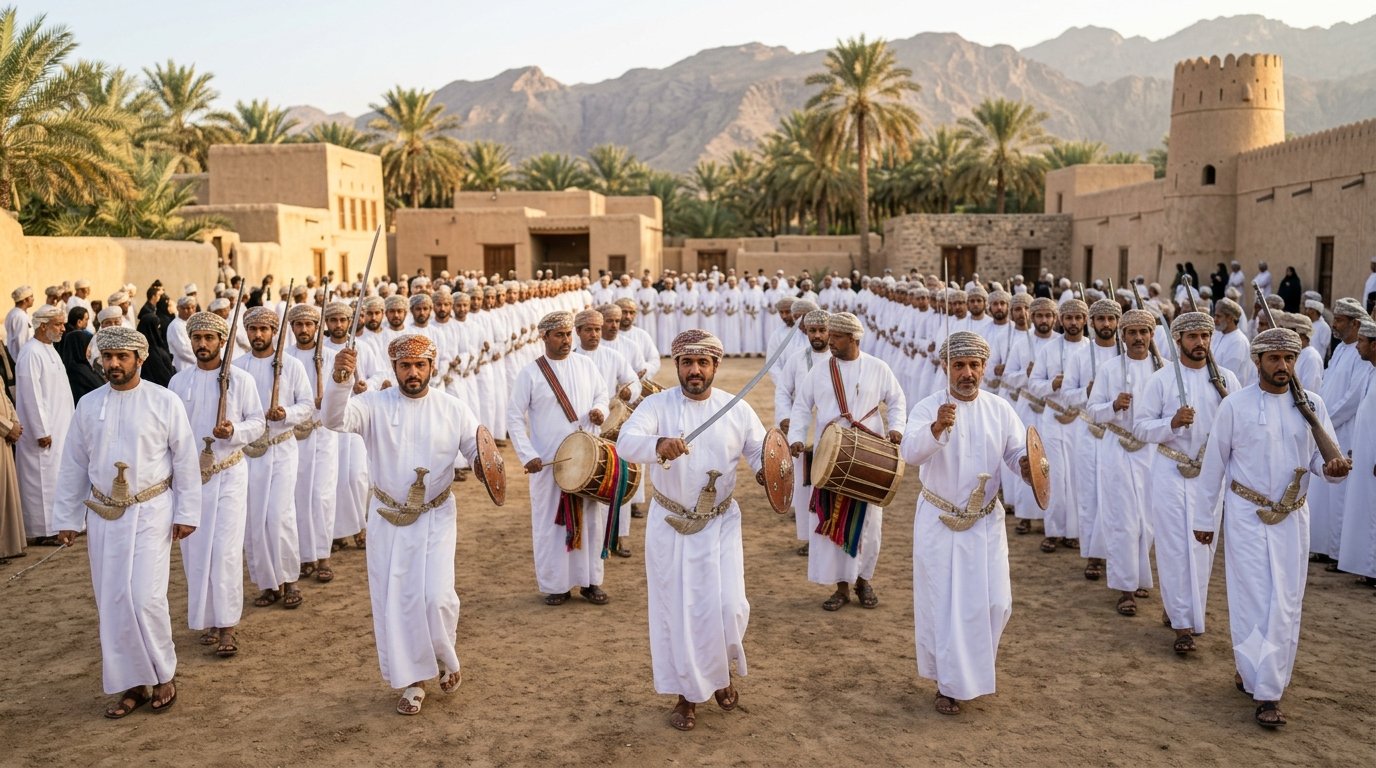
Hambal takes place in the context of movement and procession and is therefore also known by local names such as Razhat Al-Darb or Al-Mashya. It is performed when men move from the gathering place to the Al-Razha performance area, or when they leave it.
Sword and rifle bearers usually lead the procession, while the musicians form part of the procession. The men walk in organized rows, walking in rhythmic, synchronized steps. This style has a distinctly energetic character, and the rows take turns chanting poetic Shilat, transforming the procession itself into a collective musical performance.
Qassafi: A Fast and Energetic Opening
Qassafi is characterized by a faster rhythm than Lal Al-Oud and serves as an opening performance that prepares the way for the main part of the Al-Razha performance. Participants generally form two facing rows, while the drummers move through the space between the two rows. In many regions, this style is associated with the Al-Kaser and Rahmani drums, although the number of drums and the manner of performance vary from one region to another.
The importance of Qassafi is not limited to rhythm; poetry is an essential element as well. Its themes include pride, praise, courage, and enthusiasm, while its content may change according to the occasion and the social context in which Al-Razha is performed.
Lal Al-Oud: The Heart of Al-Razha
Lal Al-Oud, also known as Al-Razha Al-Kabir, is considered the most prominent of the three styles and the one most closely associated with poetic exchanges and sword displays. It is characterized by a more dignified and cohesive rhythm than the faster preceding styles, and its performance can continue for an extended period, particularly when poets engage in successive poetic exchanges.
In this style, the rows stand facing one another, while the drums and participants move through the space between them. Poets and the opposing rows take turns performing Shilat, and a Shila consists of two or three or four poetic lines dealing with a particular subject. Poetry thus becomes a means of dialogue, challenge, and response, rather than merely words accompanying the dance.
Swordsmanship: More Than Mere Spectacle
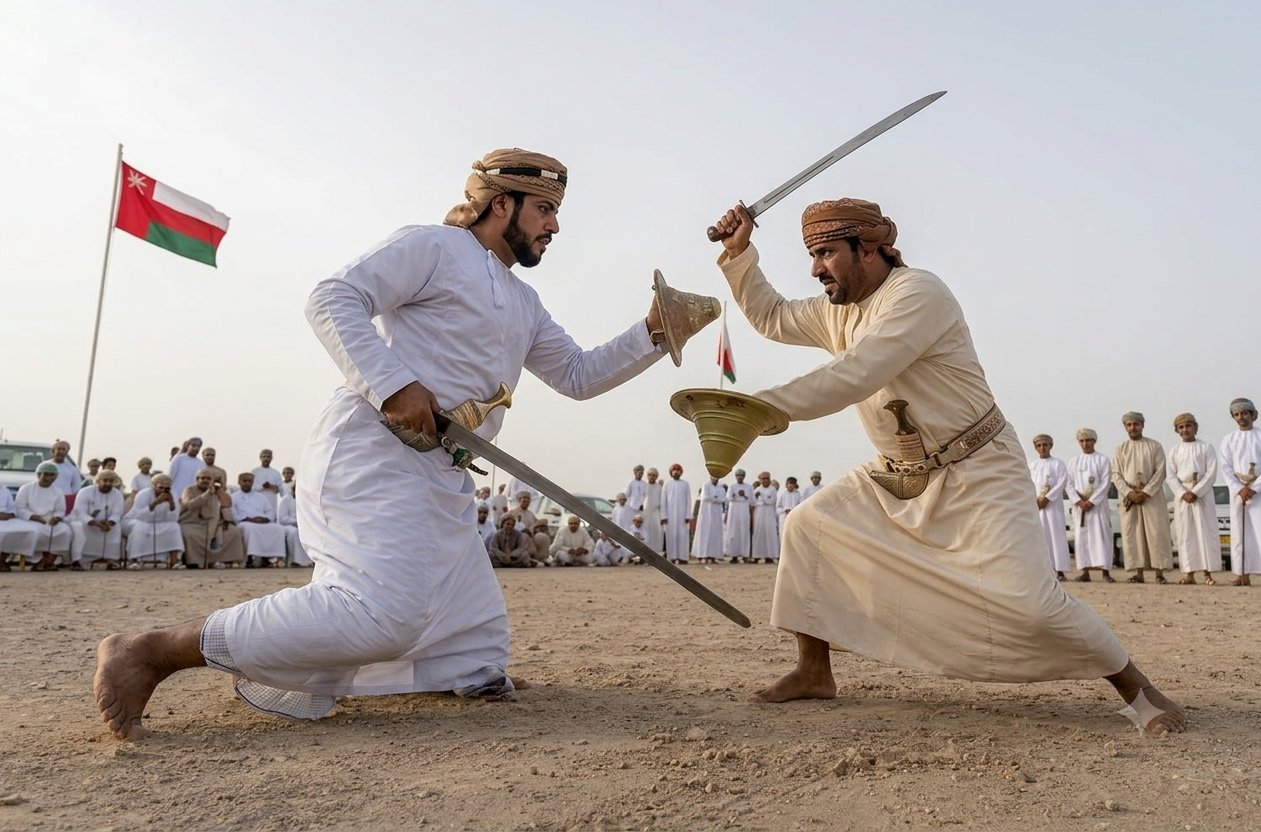
Some styles of Al-Razha are accompanied by a performance art known as Al-Zafin, which consists of a two-person sword-and-shield duel performed by skilled practitioners according to established rules, particularly in Lal Al-Oud. Al-Zafin does not appear in all styles of Al-Razha; Qassafi, for example, is not accompanied by this art because of its fast rhythm and the nature of its movements.
In some forms of the performance, two swordsmen appear with swords and shields in the space between the rows of participants, performing controlled, choreographed movements before the audience to the rhythm of the drums. In this way, the duel becomes a form of symbolic confrontation that evokes values of courage, strength, and skill, while the overall framework remains celebratory and artistic.
The use of the sword in this context does not mean that the performance retains an actual combat function. In contemporary performances, the sword also functions as an important cultural and performative symbol; movements that once evoked concepts of warfare, readiness, and courage have, in contemporary celebrations, become part of a heritage performance that conveys these values symbolically.
Poetry: The Voice and the Memory of Community
If the sword represents the visual dimension of Al-Razha, poetry represents its voice. The poems and Shilat accompanying Al-Razha can address a wide range of themes, from pride, praise, courage, and valor to advice, guidance, satire, riddles, and enigmas. In this context, the poet’s role extends beyond writing the text; the poet participates in constructing the poetic dialogue, directing the performance, and giving the occasion its meaning and substance.
Poetic exchanges are particularly important in Lal Al-Oud, where the performance can develop into an extended poetic dialogue between the poets and the rows. Here, one of the distinctive characteristics of Al-Razha becomes apparent: the interaction between word, movement, and rhythm. Poetry is inseparable from bodily movement, the drums do not operate independently of the poetry, and the movement of the sword is likewise inseparable from the collective rhythm.
Drums and Rhythm
The musical structure of Al-Razha is based primarily on traditional drums, among the most prominent of which are Al-Kaser and Rahmani. Rhythmic details and the number of drums vary according to the style and region. In Hambal, the rhythm corresponds with the steps and movement of the procession; in Qassafi, it becomes faster and more energetic; and in Lal Al-Oud, it takes on a more measured character suited to poetic exchanges and physical movements and sword displays.
This progression demonstrates that Al-Razha is not merely the repetition of a single rhythm, but rather a comprehensive performance structure capable of moving from the procession to the opening and then to the climax of poetic and spectacular performance.
Al-Razha in Contemporary Omani Society
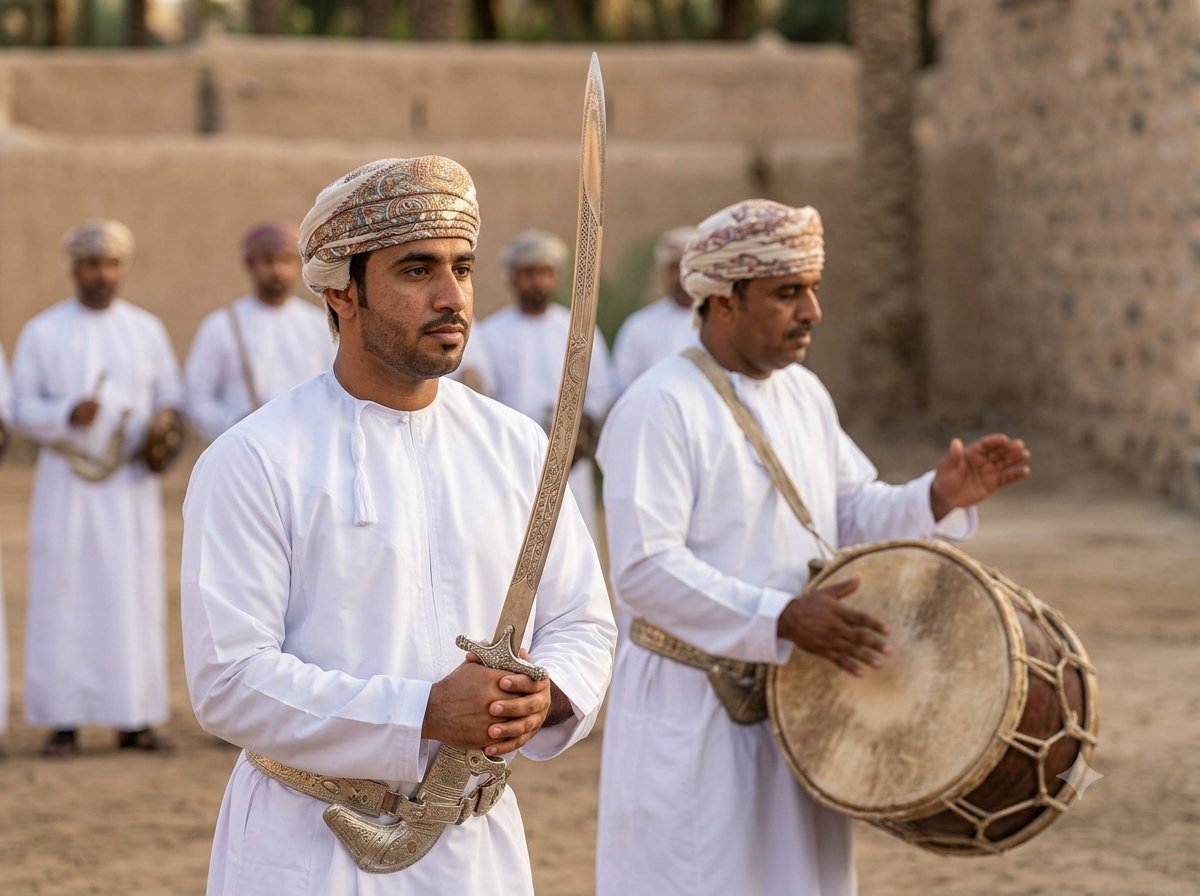
Historically, Al-Razha has been associated with various social contexts, from occasions and celebrations to demonstrations of courage and social status. It has also been connected in the cultural memory with contexts of warfare, mobilization, and the display of strength. In the modern era, it is primarily performed at social, national, and celebratory occasions, while retaining its essential elements of poetry, drums, rows, swords, and spectacle.
Its importance for tourism lies in the fact that it offers visitors an opportunity to experience Omani heritage as a living practice, rather than merely as an artifact preserved in a museum. A visitor watching Al-Razha is simultaneously witnessing traditional music, oral poetry, Omani dress, traditional objects, collective movement, and symbols associated with courage, identity, and belonging.
Thus, Al-Razha is an open-air heritage theatre in which music, poetry, movement, and social symbolism intersect. Through its various styles, Al-Razha offers one of the most vivid expressions of living Omani heritage: a heritage that does not merely revive the past, but brings it into the present before new generations and visitors arriving in the Sultanate of Oman.